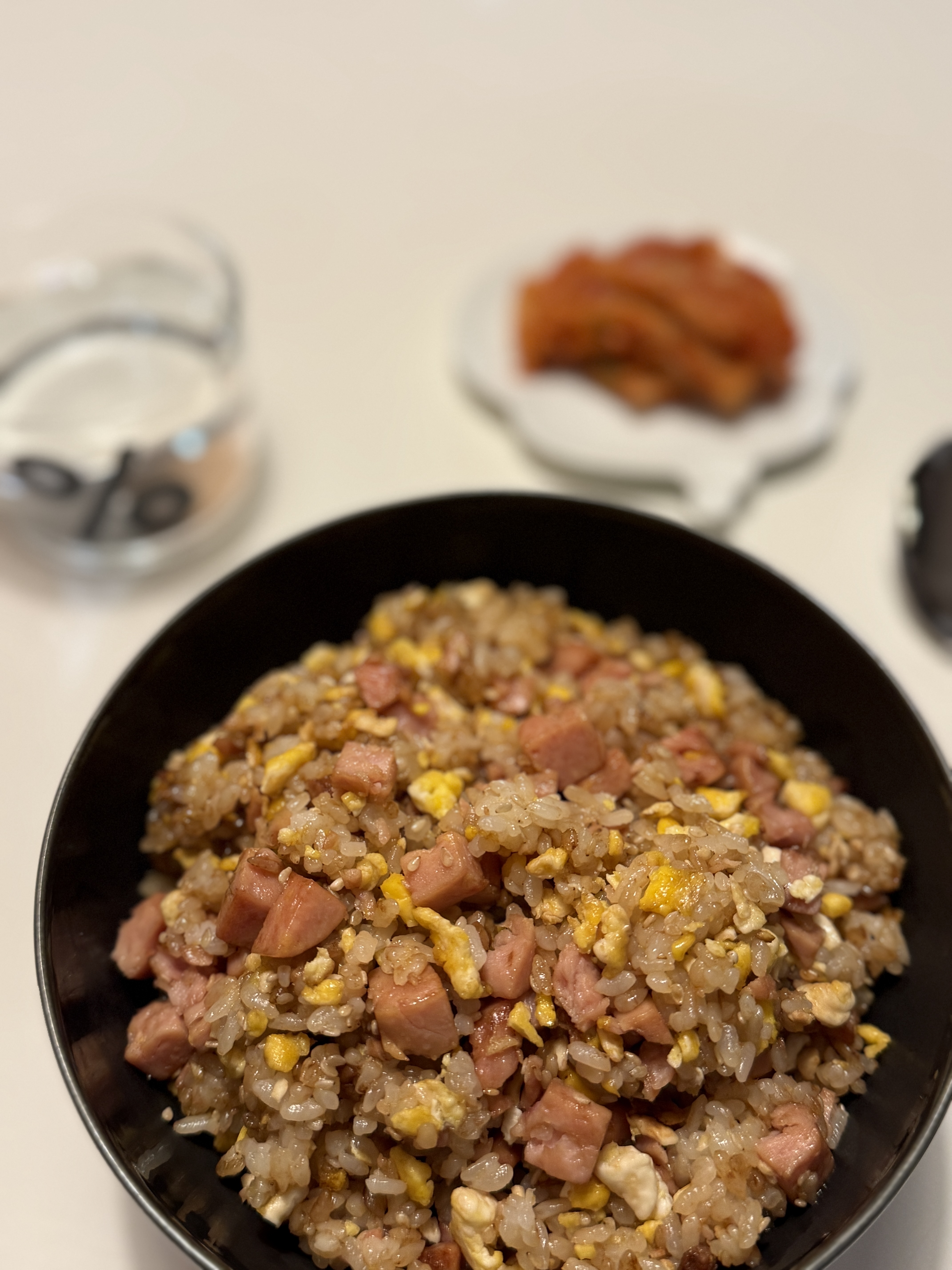
Last night, my son came home late and was feeling hungry. Since I had also just stepped inside at 10 PM, there wasn’t any food ready to serve. While he was freshening up, I needed a menu that I could whip up before he even finished his shower. When it comes to a quick and satisfying meal, nothing beats Egg Fried Rice.
In Korea, we often say that “seaweed and eggs raised our children.” These are the staple ingredients we always keep in the pantry. When kids are young, you can’t give them spicy food or overly seasoned side dishes. Amidst the chaos of parenting, these ingredients allow us to whip up a meal quickly while still ensuring they get plenty of protein. It’s a “go-to” meal that gives every mother peace of mind.
Even just wrapping plain white rice in a sheet of seaweed is a taste children absolutely love. (We use seasoned seaweed brushed with sesame oil and salt, though there are even low-sodium versions made specifically for toddlers!)
Looking at my son, who has now grown into a tall teenager, I realize that eggs are still the unsung heroes responsible for my parenting journey. ^^
Anyway, today I’m going to show you how to make this Quick Egg Fried Rice that you can pull off in just 5 to 10 minutes. It’s perfect not only as a late-night snack but also as a proper, hearty meal, so I highly recommend giving it a try!

Actually, I saw that video—the one where Jamie Oliver tried making “Korean-style” fried rice. To be honest, as a Korean, it was a complete culture shock!
The most shocking part was the way he handled the rice. Not only was the rice variety something we’d never use, but wait… he put unwashed rice straight into boiling water? And then—pardon me?—he rinsed the cooked rice under cold water?!
As a Korean who has eaten rice every single day since weaning off baby formula, that was a plot twist I never imagined in my life. (Haha!)
Usually, when I share recipes, I suggest using instant rice (like Hetbahn). For those whose staple food isn’t rice, it’s much more economical and convenient to microwave just what you need, and the quality is surprisingly excellent. But after seeing that, I feel like I must at least explain the basic way to wash and cook rice today!


How to Wash Rice the Right Way
1: Rinse and Drain Quickly (The First Wash) Place the rice in a bowl and pour in some water. Give it a quick swirl and drain the water immediately.
* The dry rice absorbs water very quickly, so you want to get rid of that first “dusty” water as fast as possible!
2: Gently Scrub the Grains With very little water left in the bowl, use your hand to gently rub the rice grains together in a circular motion. This removes any remaining starch and impurities.
(*If you’re like me and don’t want to get your hands wet (or if you want to protect your manicure!), you can use a small whisk or a rice washing tool. It works perfectly for cleaning the grains without a single drop of water touching your skin! ^^ )
3: Rinse Until Clear Add more water, swirl, and drain. Repeat this 2–3 times until the water runs relatively clear (it doesn’t have to be crystal clear, but no longer milky).
4: Drain and Measure Drain the water completely. Now your rice is clean and ready for the perfect amount of fresh water!
Now that the rice is washed and ready, shall we whip up some Egg Fried Rice? Since I had some Spam in the pantry, I decided to make Spam and Egg Fried Rice. It’s the ultimate “comfort combo” that never fails!
10-Minute Recipe: Easy Korean-Style Spam & Egg Fried Rice


Ingredients (Serving for 1)
■ 1Bowl of Cooked Rice ( Instant Rice like Hetbahn or cold leftover rice)
■ 2 Eggs
■ 1 Small can of Spam
■ 1/4 Stalk of Green onion (Scallions)
■ 2 Tablespoons Soy sauce
■ 1 Teaspoon Chicken bouillon powder
■ A pinch of Salt
■ Toasted Sesame seeds
- Slice the green onions and cut the Spam into small cubes to prepare.
- Heat the pan, drizzle with cooking oil, and sauté the green onions to create aromatic scallion oil.
: I skipped the green onions this time because I ran out, but I highly recommend including them as they add a much richer flavor to the dish. More importantly, sautéing the Spam in scallion oil is a great way to eliminate that distinct canned smell, leaving you with only the savory, delicious aroma! - Add the Spam cubes and fry them until they are golden brown and crispy.
- Push the fried ingredients to one side of the pan, then crack the eggs into the empty space to scramble them.
: I did this all in one pan to avoid extra dishes. If you prefer, you can scramble the eggs separately and set them aside on a plate. - Add the rice and mix everything together thoroughly until the ingredients are well combined.
- Add the chicken bouillon powder and mix well.
: Be careful not to add too much at once, as it can be quite salty. - Push everything to one side again and tilt the pan slightly. Pour the soy sauce into the empty space and let it bubble for a moment.
: Letting the soy sauce boil and caramelize slightly for a few seconds will infuse the entire dish with a wonderful smoky, “wok-hei” flavor! - Toss everything together so the caramelized soy sauce coats all the ingredients evenly.
- For an extra nutty aroma, sprinkle about a tablespoon of toasted sesame seeds and give it a final mix. (This step is optional)


Of course, the absolute best way to enjoy this dish is with a side of Kimchi. The spicy, tangy crunch of Kimchi perfectly balances the salty richness of the Spam and eggs. It’s a match made in heaven!
If you have some well-ripened Kimchi in your fridge, don’t forget to serve it alongside your meal. It truly completes the experience.
The History of Spam in Korea: More Than Just Canned Meat
I’ve heard that in many countries, Spam is perceived as a lower-quality processed food. Since it is canned meat, I don’t use it every day either. However, the combination of a hot bowl of white rice, a crispy slice of grilled Spam, and a bit of Kimchi is simply irresistible.
Spam’s history in Korea dates back to the Korean War(1950). During that time, food and meat were incredibly scarce. Spam from U.S. military bases became a vital source of protein. It could be stored for a long time without refrigeration and provided a rich, meaty flavor that was hard to come by. Because it helped people get through such difficult times, Spam is still treated with much more respect in Korea compared to other parts of the world.
When eaten on its own, Spam can be quite salty. But when paired with plain white rice, that saltiness is perfectly balanced, making it much more delicious.
There is even a famous dish called Budae–jjigae (Army Stew), which originated near U.S. military bases by boiling Spam and sausages together with Kimchi and gochujang. It’s a soul food that is particularly beloved by Korean men—right up there with Jeyuk–bokkeum (Spicy Pork)! I’ll make sure to bring that recipe to you next time as well.
It’s a long weekend here in Korea thanks to an extra public holiday, so I’m planning to cook some delicious homemade meals during the break. I hope you all have a wonderful weekend filled with great food as well!
Best regards from Korea,
MJay
+
And…If you’re curious about what a Korean real late-night snack looks like, check out the post below!
Leave a Reply